
An unlikely origin story
The partnership between Jacob & Co and Manchester City did not emerge from a boardroom strategy or a formal sponsorship process. According to Laurence Brannigan, the brand’s UK Director, it grew from a single pop-up inside the stadium during a match day, arranged as little more than a test. The response from those present that afternoon settled the question quickly. A gentleman at the event purchased one of the pieces on display, and the energy in the room confirmed something Brannigan had suspected: the brand and the club’s community shared a genuine affinity.
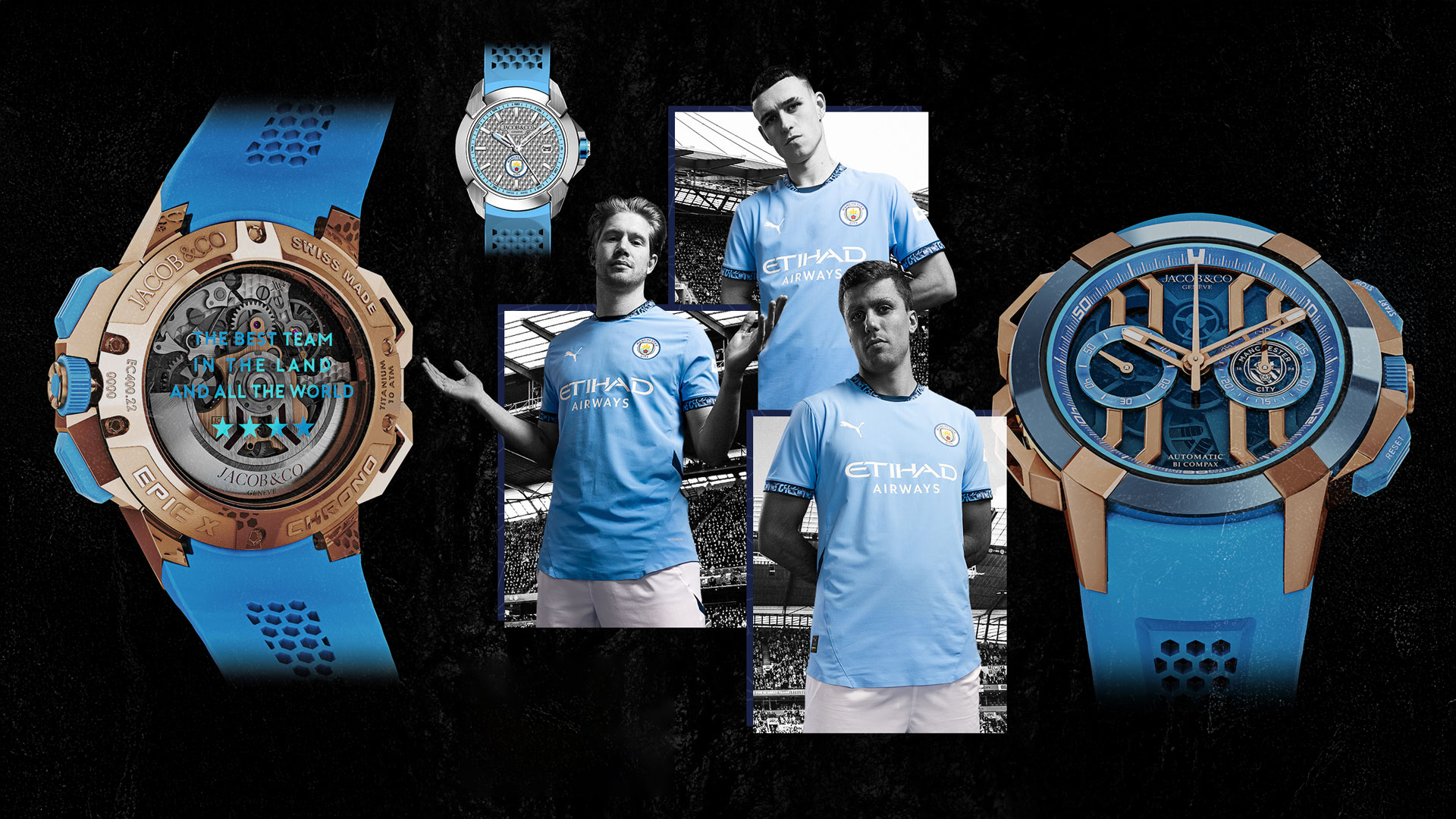
From that initial experiment, a full creative partnership took shape. Three models were developed for the collaboration. Two existing Jacob & Co pieces were adapted to incorporate the club’s colours, badge, and signature sky blue alongside rose gold, while a third was created entirely from scratch, a watch that had never existed within the brand’s portfolio before the partnership began. That bespoke piece remained exclusive to Manchester City from late 2024 through to September, before being released to the wider market in titanium following demand that made a broader launch unavoidable.
Nine months from concept to wrist
The story behind the titanium model is, in many respects, the centrepiece of what Brannigan’s team has built over the past year. The formal proposal was presented to Jacob Arabo in New York in February 2024, accompanied by a film capturing the atmosphere of match days at the stadium: the hospitality, the activations, the scale of what the club represents commercially and culturally. When the film ended, Arabo’s response was immediate. A brand founder who rarely grants a second meeting during such visits requested to see the team again the following morning.
When they reconvened, he told them he had been awake for most of the night. The concept for the dial had already formed in his mind, and he demonstrated it by producing the cap of a fragrance bottle from a wash bag he carries on his private aircraft. The diamond-cut surface of that cap, he explained, would become the dial of the new piece. The cap was couriered directly to Switzerland. Nine months later, the finished watch arrived. For a titanium model that had never previously been engineered within the Jacob & Co range, that timeline represents a significant technical undertaking.
Scarcity with purpose
The collection was issued in numbers that made any notion of widespread availability impossible. Thirty pieces were produced in golden ceramic, twenty in full gold, and 250 in titanium. The rationale, as Brannigan explained it, is rooted in a clear-eyed reading of where the premium market currently sits. Clients at this price point have, in many cases, spent years acquiring pieces from the major established houses and are now actively looking for something they are unlikely to see on another wrist. The collection was designed with precisely that in mind.
Personalisation reinforced the proposition further. Serial numbers were aligned with players’ shirt numbers, and in certain cases with buyers’ dates of birth, giving each piece a specificity that standard production watches cannot replicate. A side effect, apparently unplanned, has been the formation of a close-knit community among owners, with the club itself serving as the one context in which two people might find themselves wearing the same piece. That shared context has drawn collectors together in a way that purely transactional luxury rarely achieves.
Relationships over systems
What distinguishes Jacob & Co’s UK operation, as Brannigan describes it, is an almost deliberate rejection of the infrastructure that most businesses of comparable scale would consider standard. There are no CRM platforms managing client interactions, no automated communications, no technology standing between the team and the people they work with. Contact is made by phone, by WhatsApp, and in person. Brannigan is reachable directly, around most of the clock, and will call clients at six or seven in the morning, not to discuss watches but simply to talk.
The Manchester City partnership itself is a product of this approach. It arrived through four years of purposeful networking, eventually leading to a meeting with Eddie Rimmer at the club, who opened the door to the match-day pop-up that started everything. Brannigan is careful to distinguish between the kind of networking that builds something and the kind that simply fills a diary. The former requires a clear vision of where the business is heading and a consistent presence in the right rooms. The latter, he argues, is a considerable waste of time. The eight weeks prior to the Linz conversation had been, by his own account, the strongest period the UK operation had experienced since it was established.
Where the market stands
On the broader question of whether the luxury watch market has room for new entrants, Brannigan’s view is measured. He acknowledges meaningful crowding at what he characterises as the lower luxury tier, but sees genuine space at the premium end for brands that lead with innovation rather than heritage alone. Jacob & Co’s collectors frequently own pieces from Richard Mille, Patek Philippe, Rolex, Audemars Piguet, MB&F and Greubel Forsey. The choice to add a Jacob & Co piece to that group, he suggests, is driven by something different: a desire for personality, rarity, and a watch they will actually wear rather than store.
The brand holds multiple world firsts and active patents, and the Manchester City titanium model, developed in under a year from a fragrance bottle cap, is as concrete an illustration of that principle as any formal product brief could produce.
Technology at the edges
Brannigan’s view of artificial intelligence is specific and bounded. He sees a clear role for it in reducing administrative burden across the supply chain, from the factories in Switzerland through to final delivery, creating capacity for the human work that the brand’s offer depends upon. He is aware of consultants already engaged by Swiss houses on exactly these processes and expects visible progress within one to two years.
What he is equally firm about is where that boundary sits. The watches remain Swiss-made, hand-tooled physical objects, and nothing about that will change. The client is not buying automation. Where he does see considerable promise is in blockchain-based authentication: an unclonable microchip tied to a verified ledger entry, scannable and permanent, that would allow any buyer to confirm with certainty that what they hold is genuine. Technology companies have already raised this with the brand directly, and Brannigan believes it will become a standard feature across luxury goods more broadly, not only in watchmaking, within the near future.
The cost of distance
Running a business across the United Kingdom and Sydney has given Brannigan a particular perspective on time as a professional resource. Australia is a full day’s travel from home, and the margin for wasted hours on either side of the journey is effectively zero. He uses commercial aviation within Europe, Emirates for long haul, and private aviation for journeys where the integrity of the pieces and the quality of the client experience require a more controlled environment.
The irony of his position is not lost on him. He makes watches that measure time, but cannot manufacture more of it. That awareness shapes decisions at every level, from how journeys are planned to how client relationships are maintained. Asked what he considers the most underrated luxury available, his answer is straightforward: time spent with family. Away from home for approximately 70 to 75 per cent of the year, he and his wife now maintain a shared calendar, scheduling meaningful time with their children, friends and wider family with the same deliberate care applied to the professional diary. The insight carries a certain weight coming from someone whose working life is, in every sense, built around the clock.